
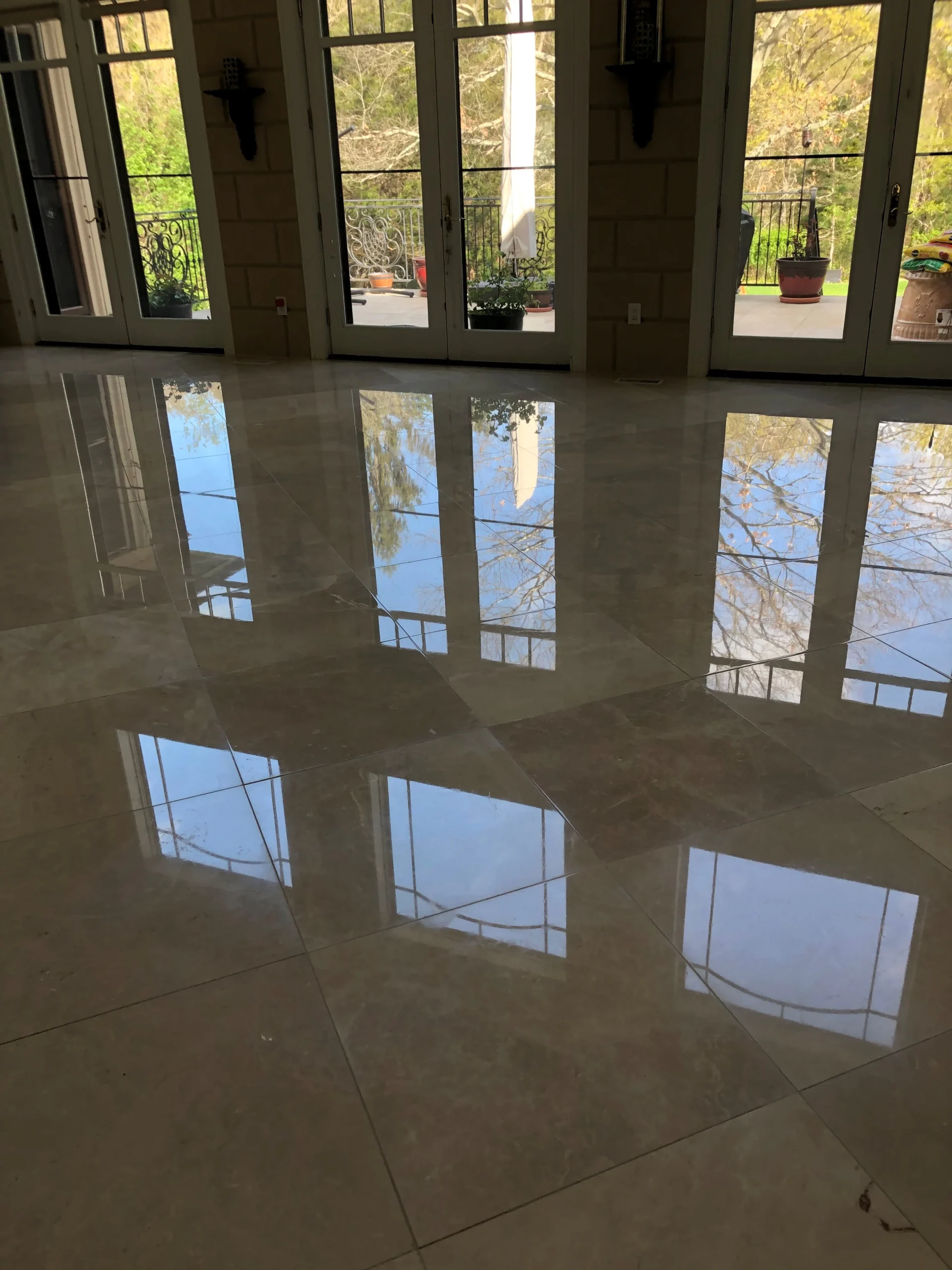
You’re not just getting shinier floors. You’re getting a surface that looks the way it did when your home was built—without the $70-190 per square foot price tag of replacement.
Most marble restoration runs $5-15 per square foot. That’s real money saved, especially on larger floors. But the bigger win is keeping the original character intact. Those century-old installations used techniques and materials you can’t replicate today.
Properly restored marble lasts 10-15 years before needing attention again. Compare that to basic cleaning services that fade in 2-3 years, and you’re looking at a real investment. The National Association of Realtors notes that well-maintained original floors can increase property value by 3-5%—buyers pay premium prices for authentic, restored features in historic Long Island homes.
Your marble gets sealed with modern protection that outperforms what was available when your floor was installed. Micro-cracks get filled. Traffic patterns disappear. The stone actually becomes more resilient than it was before.
We’ve been restoring natural stone throughout Nassau and Suffolk Counties since 1998. The New York Times featured our work in 2001 because we take on the challenging projects—the 100-year-old floors with serious damage that most contractors avoid.
Mastic and the surrounding Long Island area is full of historic properties from the Gold Coast era. Many still have original marble installations that just need proper restoration, not replacement. That’s where 25+ years of specialized experience matters.
You’re working directly with the owner on every project. No subcontractors. No handoffs. Just someone who’s spent decades perfecting these techniques and understands that your floor isn’t just stone—it’s part of your home’s history.
First, we assess the damage. Etching from acidic spills looks different than wear patterns from foot traffic. Staining requires different treatment than surface scratches. Each floor tells us what it needs.
Then we start with diamond abrasives—not harsh acids that eat away at the stone. We’re removing damaged surface layers and leveling out the inconsistencies that make your floor look dull. This is precision work. Go too aggressive and you damage historic marble. Too conservative and you don’t fix the problem.
Once the surface is level, we move through finer grits to bring back the polish. This is where you start seeing the original beauty come through. Colors deepen. Veining becomes more pronounced. The stone starts looking like stone again, not like something that’s been walked on for a century.
Final step is sealing. We use premium sealers that fill the pores and protect against future staining. Long Island’s humidity and hard water create specific challenges for marble, so we choose products that handle those conditions. Most projects take 1-3 days depending on size and condition—far less disruption than tearing out and replacing.

Ready to get started?
You get a complete assessment before we start any work. We’re looking at etching, staining, traffic patterns, cracks, and overall condition. You’ll know exactly what we’re fixing and what it costs before we touch your floor.
The restoration itself includes diamond grinding to remove surface damage, honing to level the stone, polishing to bring back the original finish, and sealing for long-term protection. If you have cracks or chips, we fill those as part of the process. Grout lines get cleaned. Edges get detailed. The whole floor gets treated, not just the obvious problem areas.
Historic homes in Mastic often have marble that’s been improperly maintained for years. Maybe someone used the wrong cleaner. Maybe the floor hasn’t been sealed in decades. We’re correcting all of that—not just covering it up. The goal is to reset your floor to proper condition so regular maintenance actually works going forward.
You also get direct communication throughout. Questions get answered by someone who knows the work, not a call center. Timelines are realistic. Pricing is transparent. And when we’re done, you get care instructions that actually make sense for your specific marble and your specific household.
Restoration typically runs $5-15 per square foot depending on condition and size. Replacement costs $70-190 per square foot for new marble installation on Long Island—that’s materials, demolition, disposal, and labor.
For a 200 square foot entryway, you’re looking at $1,000-3,000 for restoration versus $14,000-38,000 for replacement. The math gets even more dramatic on larger floors. A 500 square foot living area could cost $2,500-7,500 to restore but $35,000-95,000 to replace.
The bigger consideration is that you can’t actually replace what you have. Century-old marble was installed using techniques that don’t exist anymore. The stone itself often came from quarries that are tapped out. When you restore, you’re keeping something irreplaceable. When you replace, you’re getting modern marble that looks different and doesn’t have the same character.
Yes, but it depends on how deep the damage goes. Etching is acid damage—those dull spots from lemon juice, wine, or harsh cleaners. We remove the damaged layer through diamond abrasives and re-polish the surface. Most etching comes out completely.
Stains are different. If something soaked into the stone, we need to draw it out or grind past it. Oil-based stains, rust, and organic stains each require specific treatment. Some come out easily. Others take more work. Deep stains that have been there for decades might not come out 100%, but we can usually improve them significantly.
The key is that we’re not using acids or harsh chemicals that make the problem worse. A lot of homeowners unknowingly damage their marble by trying to clean etching with products that create more etching. We’re reversing that damage mechanically, which is the only way to actually fix it rather than just making it worse.
Properly restored and sealed marble typically lasts 10-15 years before needing another full restoration. That timeline assumes normal residential use and proper maintenance—using pH-neutral cleaners, wiping up spills quickly, and not dragging furniture across the floor.
High-traffic areas might show wear sooner. Entryways where people track in sand and grit act like sandpaper on the surface. You might see dull spots develop in those areas after 7-10 years while the rest of the floor still looks great. We can spot-treat those areas without redoing the entire floor.
The sealer we apply during restoration gives you better protection than what was originally on your floor. Modern sealers are more effective at preventing stains and moisture penetration. But they do wear down over time, especially in traffic areas. Resealing every 3-5 years extends the life of your restoration and keeps your floor protected between full restorations.
Polishing is the final step of restoration—it’s what brings back the shine. Restoration is the complete process of repairing damage, leveling the surface, and then polishing.
If your floor just looks dull but doesn’t have etching, stains, or uneven wear, polishing might be enough. We use progressively finer abrasives to smooth the surface and bring out the natural gloss. That’s a quicker, less expensive process than full restoration.
But most floors that are 50+ years old need actual restoration. There’s etching from decades of acidic exposure. There are traffic patterns worn into the stone. There might be cracks, chips, or areas where previous repairs failed. Polishing alone won’t fix those issues—you need to grind down past the damage first, then hone the surface level, and finally polish. That’s restoration. It’s more involved, takes longer, and costs more, but it’s what actually fixes a damaged floor rather than just temporarily making it shinier.
That’s specifically what we focus on. Historic marble requires different knowledge than modern installations. The materials are different. The installation techniques are different. Even the way the stone responds to restoration is different.
Many historic Long Island properties—especially those built during the Gold Coast era—have marble from quarries that don’t operate anymore. The stone has unique characteristics. It might be softer or harder than modern marble. It might have veining patterns you can’t find today. Understanding how to work with these materials without damaging them takes experience.
We’ve been restoring century-old floors throughout Nassau and Suffolk Counties since 1998. The New York Times featured our work because we take on the challenging historic projects that other contractors turn down. When you have original marble that’s part of your home’s character and history, you need someone who understands preservation, not just surface refinishing. That’s the difference between restoration that maintains value and work that diminishes what makes your floor special.
There’s dust and equipment involved, but we contain it. We use dust extraction systems that capture most of the particles during grinding and polishing. We seal off the work area from the rest of your home. And we clean thoroughly when we’re done.
Most residential projects take 1-3 days depending on square footage and damage severity. You’ll need to stay off the floor during that time, and there will be noise from the equipment. But it’s nothing like the disruption of replacement, which involves demolition, disposal, subfloor work, and installation—often taking a week or more.
The biggest inconvenience is usually just planning around the timeline. If we’re doing your entryway, you might need to use a different door for a couple days. If it’s a bathroom, you’ll need an alternate bathroom while we work. We’re direct about what to expect so you can plan accordingly. No surprises, no extended timelines, no leaving your home torn up longer than necessary.