


You’re looking at your marble floor wondering if it’s time to rip it out and start over. The dullness has been building for years. The etching from cleaning products won’t go away. Maybe you’ve tried DIY fixes that only made things worse.
Here’s what most people don’t realize: professional marble floor restoration costs $2 to $3 per square foot. Replacement runs $15 to $30 per square foot—sometimes more if your marble is historic or custom. You’re looking at saving 80% or more by restoring instead of replacing.
But the real value isn’t just financial. If your home was built before 1980—and many Woodbury properties were—your marble floors are likely irreplaceable. The craftsmanship, the material quality, the character they bring to your home can’t be replicated with modern installations.
Proper marble floor polishing and refinishing can extend the life of your floors by 25 years or more. You get the beauty back, the value stays in your home, and you avoid the disruption of a full replacement project.
We’ve been restoring marble floors since 1998. We’ve worked on everything from Gold Coast estate properties to vintage homes throughout Nassau County—the kinds of projects where one wrong move can damage irreplaceable materials.
This is owner-operated work. You’re not dealing with subcontractors or rotating crews. The person who assesses your floor is the same person who restores it.
Woodbury sits in the heart of Nassau County’s historic corridor, where homes from the early 1900s feature original marble installations that have survived decades. These floors need someone who understands old materials, period construction methods, and how to work with stone that’s been in place for a century. That’s the work we specialize in—and the work we’ve been featured in the New York Times for doing well.
The process starts with assessment. Not every marble floor needs the same level of work, and we’re not going to sell you services you don’t need. We look at the stone’s condition, identify what’s causing the damage, and give you a transparent quote based on what your floor actually requires.
Once we start, the first step is proper cleaning—not with harsh chemicals that etch the surface, but with pH-neutral solutions that remove buildup without causing new damage. Most of the dullness you’re seeing is from years of wrong products creating micro-etching across the surface.
Next comes honing and polishing. This is where we remove scratches, etching, and surface damage, then rebuild the finish using progressively finer abrasives. It’s skilled work that requires understanding how different marble types respond to different techniques. Rush it or use the wrong approach, and you can ruin the stone permanently.
The final step is sealing. A proper sealer protects against staining and makes regular maintenance easier. Most marble floor restoration projects take one to three days depending on square footage and condition. You’re not living through weeks of construction—most clients are back to normal life within 48 hours.

Ready to get started?
You get a complete assessment before any work begins. We identify the type of marble, the extent of damage, and whether restoration makes sense or if you’re looking at a replacement situation. That honest evaluation is part of the service—not every floor can or should be restored.
The restoration itself includes deep cleaning, honing to remove damage, polishing to rebuild the finish, and sealing for protection. If you have specific problem areas—heavy etching near a bathroom, cracks from settling, chips from dropped objects—those get addressed as part of the process.
Nassau County’s housing stock includes thousands of homes built between 1920 and 1980, many featuring original marble in entryways, bathrooms, and kitchens. These installations face challenges modern floors don’t: decades of settling, outdated underlayment, exposure to cleaning products that weren’t formulated for natural stone. We account for these factors during restoration.
You also get guidance on maintenance. The reason your floor looks the way it does now is probably related to how it’s been cleaned over the years. We’ll show you what products to use, what to avoid, and how to keep the restored finish looking good for the next 20+ years. That knowledge is as valuable as the restoration itself.
Professional marble restoration typically costs $2 to $3 per square foot. Full replacement runs $15 to $30 per square foot or more, depending on material quality and installation complexity. For a 200-square-foot entryway, you’re looking at $400 to $600 for restoration versus $3,000 to $6,000 for replacement.
The cost difference gets even more dramatic with historic marble. If your floor is original to a pre-1950 home, matching that material quality and craftsmanship with modern products is nearly impossible. You’d be paying premium prices for inferior results.
Restoration also takes less time. Most projects are complete in one to three days. Replacement means demolition, disposal, subfloor prep, new installation, and curing time—often two weeks or more of disruption to your daily routine.
Yes, and this is one of the most common problems we see. Most household cleaners—even ones marketed as “natural” or “safe”—are too acidic for marble. They create etching, which looks like dull spots or watermarks that won’t buff out.
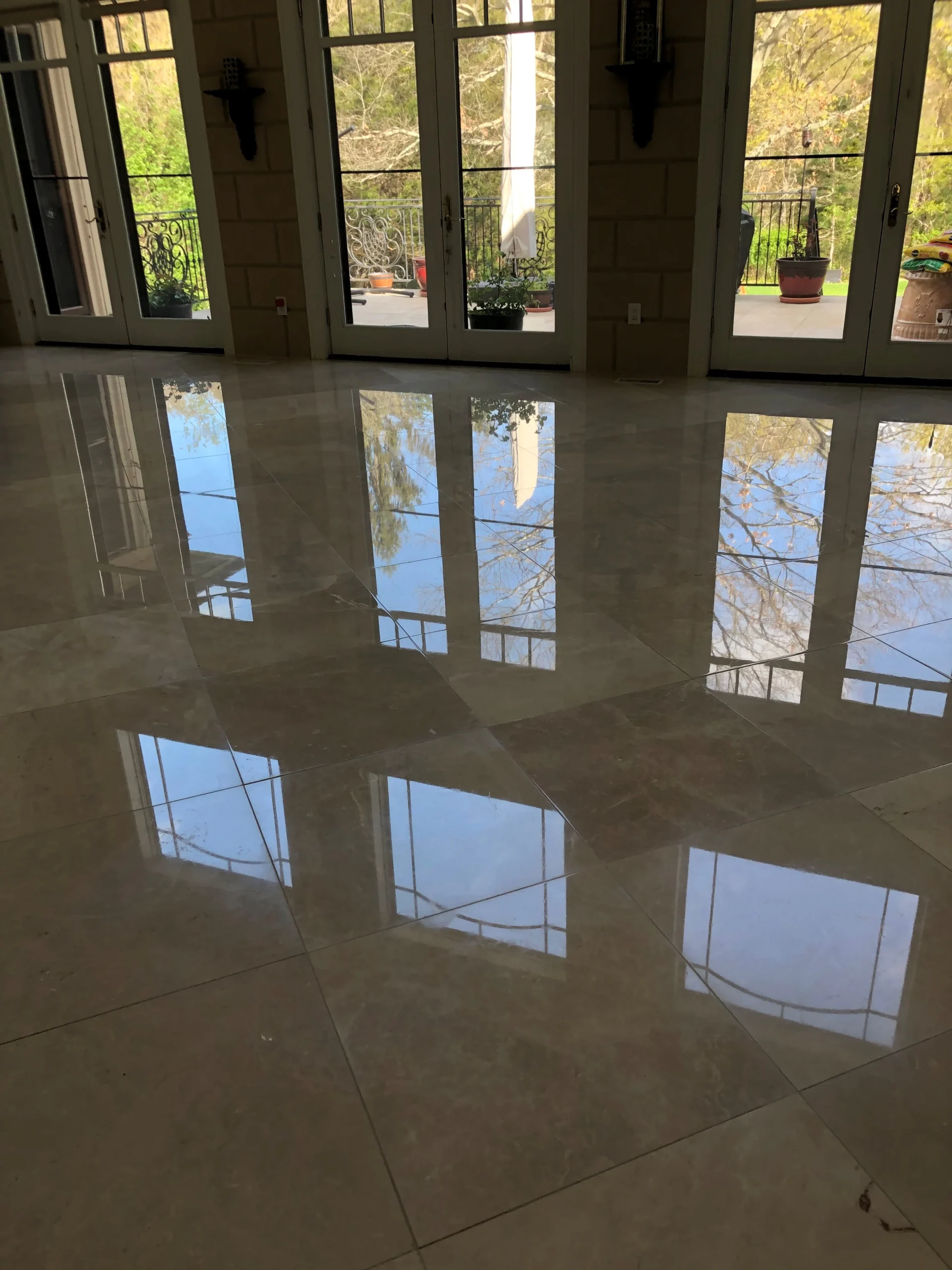
The good news is etching is surface damage. It hasn’t penetrated deep into the stone. Professional honing removes that damaged surface layer, then polishing rebuilds the finish. The marble underneath is still intact and beautiful.
The key is stopping the damage now. Every time you clean with the wrong product, you’re making the problem worse. Once we restore your floor, we’ll show you exactly what to use for regular cleaning—products that won’t etch the surface or dull the finish over time.
Properly restored and maintained marble can go 15 to 25 years before needing professional refinishing again. That timeline depends on foot traffic, how well you maintain it, and whether you’re using the right cleaning products.
High-traffic areas like entryways will show wear sooner than a bathroom floor. But even in heavy-use spaces, you’re looking at a decade or more of beautiful floors if you take care of them correctly.
The maintenance isn’t complicated. Use pH-neutral cleaners, wipe up spills quickly, and put mats at entrances to catch dirt and grit. Those simple habits make the difference between floors that last 25 years and floors that need work again in five.
Polishing is the final step in restoration—it’s what creates the glossy finish. But polishing alone won’t fix a damaged floor. If your marble has etching, scratches, stains, or dullness, it needs honing first to remove that damage.
Think of it like refinishing wood floors. You can’t just slap a coat of polyurethane over scratched, stained wood and expect good results. You have to sand it down first. Honing is the equivalent for marble—it removes the damaged surface so polishing can create a proper finish.
Some companies offer “polishing” services that are really just buffing with compounds. That might add temporary shine, but it doesn’t address underlying damage. Within weeks or months, the problems show through again. True marble refinishing involves honing and polishing together—removing damage and rebuilding the finish from scratch.
Yes, and that’s exactly the type of work we specialize in. Historic marble requires different techniques than modern installations. The stone is often softer, the underlayment may have settled or shifted over decades, and previous repair attempts may have caused additional damage.
Woodbury and the surrounding Nassau County area have thousands of homes built during Long Island’s estate era—1890s through 1940s—when quality marble was standard in high-end construction. These floors have survived a century because they were built right. Our job is to restore them without compromising that original craftsmanship.
We’ve worked on marble floors in Gold Coast properties, vintage homes throughout the North Shore, and everything in between. The approach is always the same: assess what you’re working with, use techniques appropriate for the age and condition of the stone, and restore it to original beauty without causing new damage. That’s specialized work that requires experience with historic materials—not something every marble restoration company can handle.
If your marble is original to a historic home, restoration is almost always the better choice. You’re preserving authentic materials that add value and character to your property. Buyers specifically seek out homes with original details, and restored marble floors can increase property value by 3% to 5% according to real estate data.
Replacement makes sense if the marble is cracked beyond repair, if the subfloor has structural issues, or if the stone has been damaged by previous poor restoration attempts. But those situations are rare. Most marble floors that look “too far gone” can actually be brought back with proper restoration techniques.
The decision often comes down to whether you value authenticity or want a completely different look. Restoration gives you back what you originally had—the same stone, the same character, the same craftsmanship. Replacement gives you something new, but you lose the historic value and distinctive quality that came with the original installation. For most Woodbury homeowners with period properties, restoration is the clear winner both financially and aesthetically.