


Your marble floors aren’t just old—they’re irreplaceable. The veining patterns, the color variations, the craftsmanship from the 1920s and 1930s that built most of University Gardens can’t be found in modern materials. When you restore instead of replace, you’re keeping that authenticity intact.
You’re also keeping a lot more money in your pocket. New marble installation runs $70 to $190 per square foot. Professional restoration? A fraction of that cost, typically $2 to $3 per square foot for most jobs.
But here’s what matters more than cost: you get your floors back. Not some modern substitute, but the actual stone that’s been in your home for decades. The same marble that’s survived settling, foot traffic, and time. We bring it back to a finish that looks like it was installed yesterday, without ripping out what’s already there.
Most restoration projects wrap up in under two days. You’re not living through weeks of demolition, subfloor work, and installation. You’re watching a transformation happen in real time—and walking on it the same day.
We’ve been restoring historic floors across Nassau and Suffolk Counties since 1998. We’re owner-operated, which means the person who answers your call is the same person overseeing your job. No subcontractors. No handoffs.
University Gardens is full of the kind of work we do best—Tudors and historic homes from the 1920s and 1930s with original marble that’s seen a century of life. We’ve worked on floors in worse condition than you’d think possible, and brought them back. The New York Times featured our work in 2001. The Garden City Hotel has trusted us exclusively for over 16 years.
We don’t work on porcelain. We don’t do cookie-cutter jobs. We focus on marble, terrazzo, and now concrete restoration—materials that require real expertise and a careful hand. If your floor is 100 years old and everyone else has told you it’s too far gone, that’s exactly the kind of project we want.

We start with an assessment. Not every floor needs the same approach, especially in older homes where settling, cracks, or previous bad repairs have left their mark. We look at the stone type, the condition of the grout, whether there’s structural movement underneath, and what kind of finish you’re starting with.
Then we go to work. For most jobs, that means grinding down the surface to remove scratches, etching, stains, and any old coatings that have yellowed or worn unevenly. We’re not talking about a light buffing—this is a full resurface using diamond abrasives that bring the marble back to a flat, clean plane.
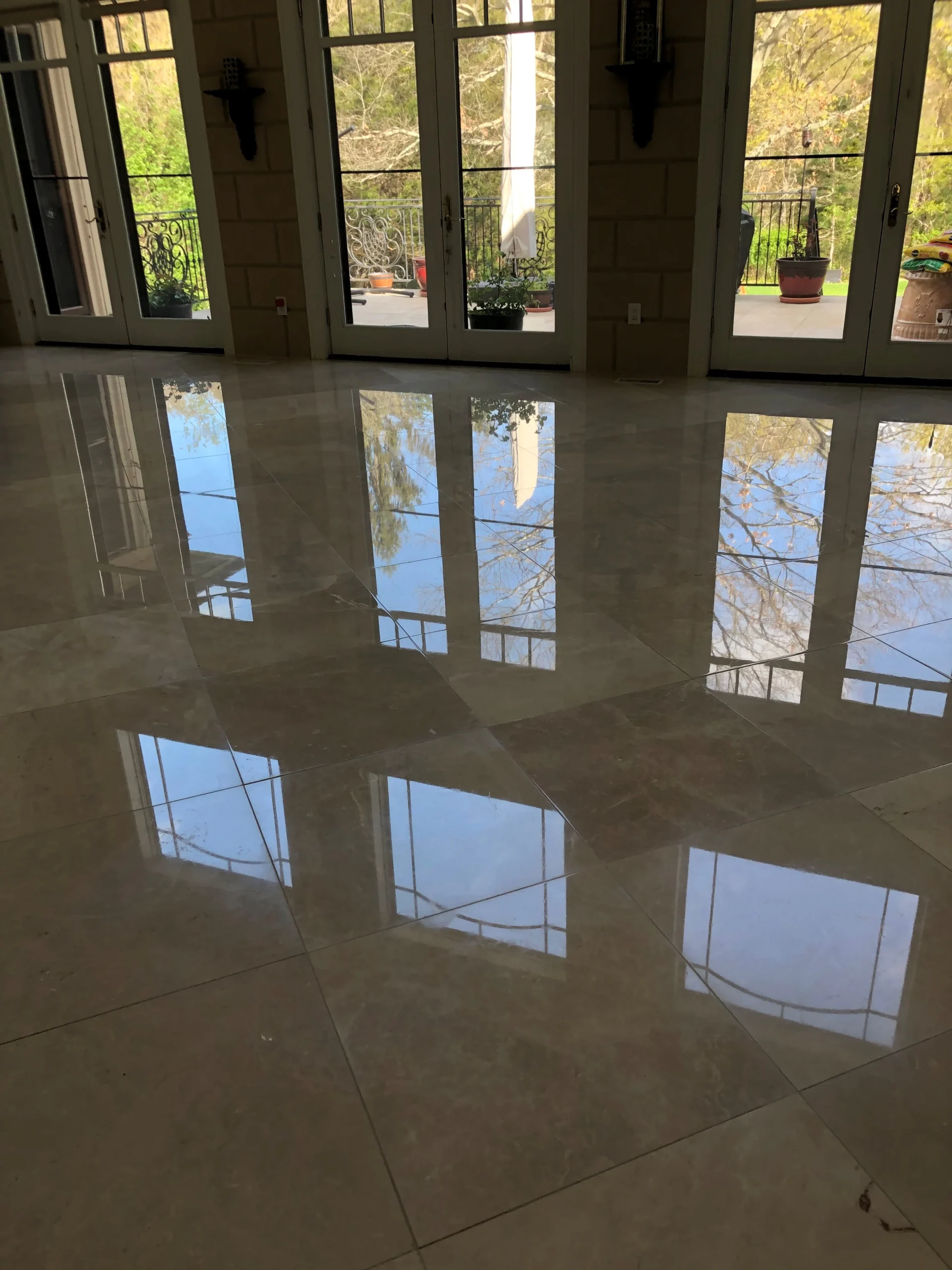
After grinding, we move through progressively finer grits to refine the surface. This is where the stone starts to come back to life. You’ll see the color deepen and the veining pop. We hone it to the finish you want—matte, satin, or high-gloss polish.
If there are cracks or chips, we fill and blend them during the process. If grout lines are failing, we address that too. The goal is a floor that looks intact and cohesive, not patched together. Most straightforward restoration jobs take one to two days. You’re walking on it the same day we finish.

Ready to get started?
You’re getting an owner-operated company that’s been doing this for over 25 years. That means transparency on pricing, no surprise fees, and direct communication from start to finish. We give you a free quote upfront so you know exactly what you’re paying for.
You’re also getting someone who knows how to handle the specific challenges that come with historic homes in University Gardens. The marble in these homes wasn’t installed the same way modern floors are. The substructures are different. The settling patterns are different. The stone itself often came from quarries that no longer exist. We’ve worked on enough of these floors to know what we’re looking at and how to approach it without causing more damage.
We also handle marble refinishing and ongoing marble floor care. Once your floors are restored, they’ll need maintenance—but it’s minimal. An annual polish runs $200 to $600 depending on square footage, and it keeps the stone looking sharp for decades. Compare that to replacing your floors every 20 years, and the math is pretty clear.
If you’re in University Gardens and you’ve got marble that’s been neglected, stained, scratched, or written off by other contractors, we’ll take a look. The worse the condition, the better the transformation.
Restoration typically costs $2 to $3 per square foot for most projects. Full marble replacement runs anywhere from $70 to $190 per square foot when you factor in demolition, disposal, new material, and installation. For a 500-square-foot area, you’re looking at $1,000 to $1,500 for restoration versus $35,000 to $95,000 for replacement.
The cost difference is significant, but it’s not the only factor. Replacement means weeks of disruption—tearing out old floors, prepping subfloors, waiting for materials, installation, curing time. Restoration is usually done in one to two days for straightforward jobs. You’re back to normal almost immediately.
And here’s the part most people don’t think about until it’s too late: new marble doesn’t look like old marble. The stone quarried today doesn’t have the same character, the same veining, or the same patina that develops over decades. If you’re in a historic home in University Gardens, replacing original marble with modern material changes the entire feel of the space.
Yes. In fact, century-old floors are some of the most satisfying projects we take on. Marble from that era is often higher quality than what’s available today—denser, more durable, with richer color and more distinctive veining. The stone itself is usually in better shape than you’d expect. It’s the surface that’s taken a beating.
The challenges with older floors aren’t usually the marble—they’re the installation methods and what’s happened to the substructure over time. Homes settle. Grout fails. Previous owners might have tried DIY repairs or hired someone who used harsh chemicals that etched the stone. We’ve seen floors that looked completely destroyed come back to a finish that’s indistinguishable from new.
The key is knowing how to assess what you’re working with. Some floors need structural work before we can polish them. Some have cracks that need stabilizing. But the marble itself? It’s built to last another 100 years if it’s cared for properly. We’ve restored floors in Gilded Age mansions and early 1900s estates across Nassau County, and the results speak for themselves.
Polishing is maintenance. Restoration is repair. If your floors are in decent shape—just dull, lightly scratched, or showing normal wear—polishing brings back the shine without aggressive grinding. It’s a surface-level treatment using finer abrasives and compounds to enhance the finish.
Restoration is what you need when there’s real damage. Deep scratches, etching from acidic spills, stains that have penetrated the stone, uneven wear patterns, or a finish that’s been ruined by the wrong cleaning products. Restoration means grinding the surface down to remove all of that, then honing and polishing it back to a uniform finish.
Most historic floors in University Gardens need restoration, not just polishing. Decades of foot traffic, improper cleaning, and neglect leave marks that can’t be buffed out. The good news is that marble is thick enough to handle multiple restorations over its lifetime. You’re not wearing the stone down to nothing—you’re removing a thin layer to reveal clean, undamaged material underneath. Once restored, regular polishing every year or two keeps it looking great without needing another full restoration for decades.
Most straightforward restoration projects take one to two days. That includes grinding, honing, and polishing. You can walk on the floors the same day we finish—there’s no curing time or drying period like there is with coatings or sealers.
Larger projects or floors with structural issues take longer. If we need to repair cracks, re-grout, or address subfloor problems, that adds time. But we’ll tell you upfront during the assessment what the timeline looks like. No surprises.
Compare that to replacement, which can take weeks. You’re dealing with demolition, subfloor prep, material delivery delays, installation, grouting, and then waiting for everything to cure before you can use the space. Restoration is faster, cleaner, and a lot less disruptive to your daily life. Most clients are shocked at how quickly the transformation happens—and how little mess is involved when it’s done right.
Yes. Well-maintained original floors are a selling point, especially in historic homes. The National Association of Realtors estimates that quality flooring can increase property value by up to 25%, and historic homes with original materials in good condition often see a 3% to 5% value bump specifically from preserved features.
Buyers looking at homes in University Gardens aren’t shopping for flips with builder-grade finishes. They’re looking for character, craftsmanship, and authenticity. Original marble floors in excellent condition signal that the home has been cared for. It’s a tangible example of quality that modern materials can’t replicate.
But even if you’re not selling anytime soon, restoration is still the smarter financial move. You’re extending the life of your floors for decades at a fraction of the cost of replacement. And you’re keeping the irreplaceable—stone that matches the era of your home, with characteristics that literally don’t exist in today’s market. That’s value you can’t put a price on, but buyers absolutely notice it.
Absolutely. Marble is calcium-based, which means it reacts to acids. Vinegar, lemon-based cleaners, most bathroom cleaners, and even some “natural” products will etch the surface. That etching looks like dull spots or watermarks, and it’s permanent damage to the finish—it won’t buff out with regular cleaning.
We’ve seen floors ruined by well-meaning homeowners who thought they were doing the right thing. We’ve also seen damage from cleaning companies that didn’t know what they were working with. Once the finish is etched, the only fix is restoration. You have to grind down past the damaged layer and re-polish.
The right way to clean marble is simple: pH-neutral cleaner and water. That’s it. No acids, no abrasive scrubbers, no harsh chemicals. For day-to-day maintenance, a damp mop and a stone-safe cleaner will keep your floors looking good between professional polishing. If you’re not sure what’s safe to use, ask before you clean. It’s a lot easier to prevent damage than it is to fix it after the fact.