

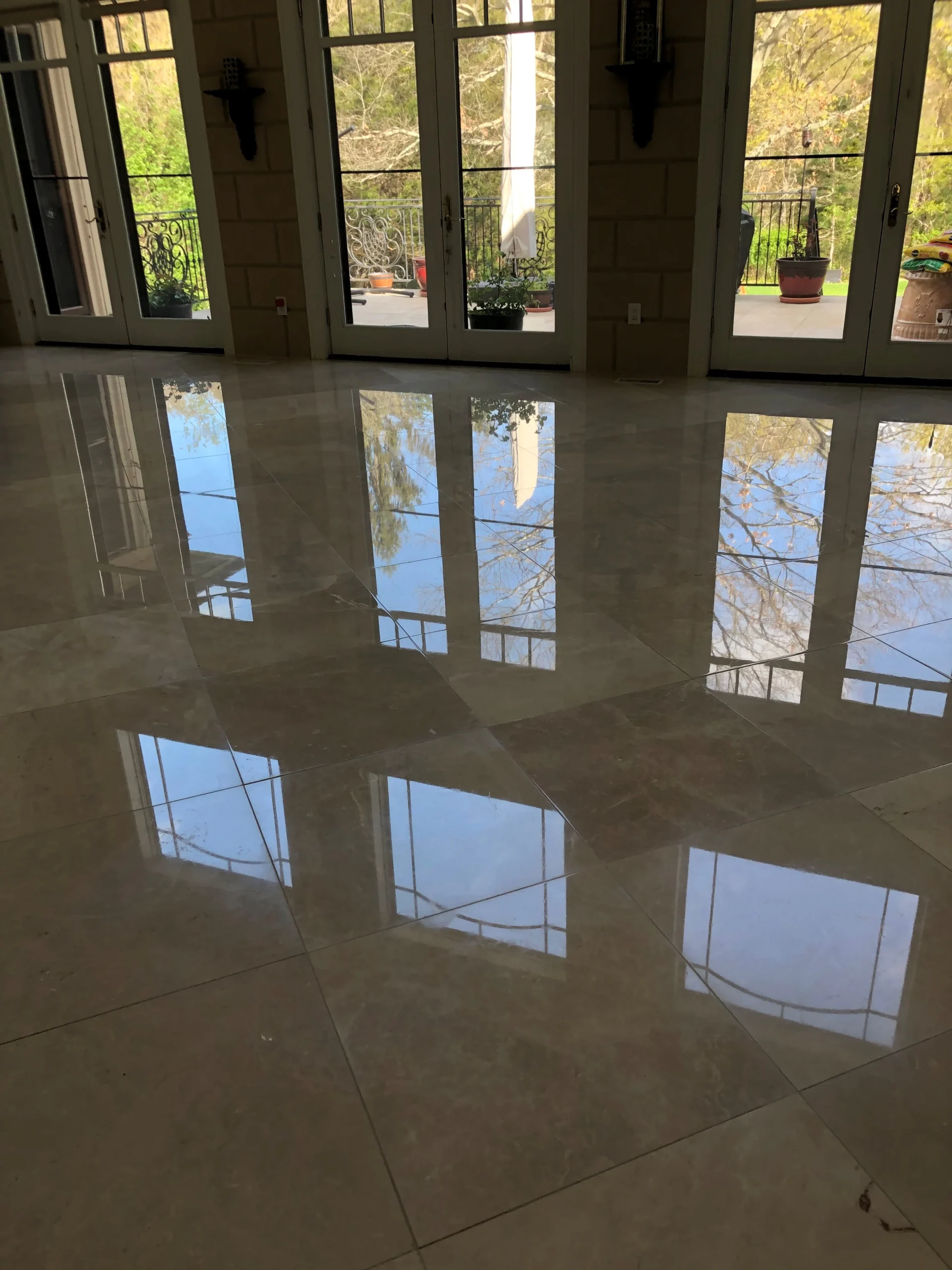
Your marble looks like it did when it was first installed. The cloudiness from years of acidic cleaners disappears. The etching, the dullness, the worn traffic patterns—gone.
You’re not covering up damage or applying a temporary fix. The stone itself is being restored using techniques that respect what it actually is: a natural material that responds to proper care. Most restoration work costs between $5 and $15 per square foot. Compare that to $70 to $190 per square foot for new marble installation on Long Island, and you see why replacement rarely makes sense.
The process takes one to three days depending on size and condition. Your bathroom or kitchen isn’t out of commission for weeks. There’s no construction debris, no ripping out historic materials you can’t replace, no losing the character that makes your home worth preserving in the first place.
And if you’re in a historic property—which many homes near Stony Brook University are—you’re keeping original craftsmanship intact. That matters when it comes time to sell. Buyers pay more for authentic, well-maintained features.
High Definition Marble Restoration Inc has been restoring marble floors across Nassau and Suffolk Counties for over 25 years. The New York Times featured our work in 2001. The Garden City Hotel has used our services exclusively for more than 16 years.
This is an owner-operated business. You’re dealing directly with the person doing the work—no subcontractors, no middlemen. When you call, you’re talking to someone who’s spent decades working on historic Long Island properties, including the century-old homes common around Stony Brook.
The worse the floor, the better. That’s not a sales line—it’s what we actually prefer. Challenging restoration projects on historic marble floors are what we’ve built our reputation on. If other contractors have told you it’s too far gone, that’s usually when we get the call.
First, we assess the damage. Not all marble problems are the same. Etching from acidic cleaners is different from physical scratches, which is different from staining. Each requires a specific approach.
Next comes the actual restoration. We use water-lubricated grinding tools that keep 99% of the work dust-free. The marble shavings stay trapped in liquid and get vacuumed up. No mess spreading through your house. The process involves progressively finer abrasives to remove damage and bring the stone back to its original finish—whether that’s a high polish or a softer honed look.
For historic floors, we’re especially careful. These materials were often installed using techniques you can’t replicate today. The goal isn’t just to make it look good—it’s to preserve what’s actually there. That means understanding how different types of marble respond to restoration and adjusting methods accordingly.
After polishing comes sealing. Proper sealing protects against future staining and etching, but it has to be done right. Too much sealer or the wrong type creates its own problems. We match the sealer to your specific marble type and how the space gets used.
Most jobs wrap up in one to three days. You get a transparent price upfront—no surprises once work starts.

Ready to get started?
We handle marble floor polishing, marble refinishing, full restoration on damaged or historic floors, and marble repair for cracks, chips, or etching. We also restore and polish concrete—a service most marble companies don’t offer but one that’s increasingly relevant for Long Island properties mixing old and new materials.
One thing we don’t do: porcelain. It’s a completely different material that requires different tools and techniques. We focus on natural stone because that’s where our expertise matters most.
Living near the coast means your marble faces specific challenges. Nassau and Suffolk Counties sit right on the Atlantic, which means higher humidity year-round. That constant moisture affects marble differently than it would in a drier climate. It can accelerate staining, encourage mold in grout lines, and affect how sealers perform over time. We account for these local conditions when we restore your floors.
If your home was built during Long Island’s estate era—roughly 1900 to 1940—there’s a good chance your marble floors are original. That marble was often sourced from quarries that no longer exist or no longer produce the same quality stone. You can’t just rip it out and replace it with something equivalent. Restoration isn’t just cheaper—it’s often your only option if you want to keep what makes your home special.
Most residential marble restoration projects take one to three days depending on the size of the area and the condition of the stone. A single bathroom might be done in a day. A large foyer or multiple rooms could take two to three days.
The timeline also depends on what we’re fixing. Light etching and dullness from improper cleaning products can be addressed faster than deep scratches, cracks, or severe staining that’s penetrated the stone. During the initial assessment, we’ll give you a specific timeframe based on what your floors actually need.
One advantage of restoration over replacement: you’re not dealing with demolition, disposal, new material delivery, or installation time. The floor stays in place. We work on it, seal it, and it’s ready to use. No extended construction timeline, no waiting for materials to arrive, no coordinating multiple trades.
Yes. Acidic cleaner damage is one of the most common problems we see, especially in older homes where people have been using standard household products not meant for marble. The acid eats away at the stone’s surface, creating a cloudy, etched appearance that gets worse over time.
The good news: etching is surface-level damage. It hasn’t penetrated deep into the stone. Restoration involves carefully removing that damaged surface layer using progressively finer abrasives until we reach undamaged marble underneath. Then we polish it back to its original finish.
The process is very different from trying to “buff out” etching with store-bought products, which usually makes things worse. You need the right tools, the right abrasives, and an understanding of how much material to remove without going too far. That’s where experience matters. We’ve been doing this for over 25 years—we know exactly how marble responds at each stage of restoration.
Significantly cheaper. Most marble restoration runs $5 to $15 per square foot depending on condition and finish. New marble installation on Long Island costs $70 to $190 per square foot when you factor in materials, labor, demolition, and disposal of the old floor.
For a 200-square-foot foyer, you’re looking at roughly $1,000 to $3,000 for restoration versus $14,000 to $38,000 for replacement. The cost difference is substantial, and that’s before considering the value of keeping original materials in a historic home.
Replacement also takes longer and creates more disruption. You’re dealing with jackhammers, debris removal, subfloor prep, new stone delivery, cutting, setting, grouting, and sealing. Restoration keeps your existing floor in place and brings it back to original condition in a fraction of the time. For most homeowners, especially those in historic properties where the marble itself has value beyond just function, restoration is the smarter financial decision.
Polishing is the final step in restoration, but it’s not the same thing as full restoration. If your marble is in decent shape—just dull or lacking shine—polishing alone might be enough. We use fine abrasives and polishing compounds to bring back the glossy finish without removing much material.
Full restoration is what you need when there’s actual damage: etching, scratches, stains, cracks, or uneven wear patterns. That requires starting with coarser abrasives to remove the damaged layer, then working through progressively finer grits until the surface is smooth and level. Only then do we polish.
Think of it like refinishing a wood floor. If the finish is just worn, you might get away with a light buffing and recoating. But if the wood itself is scratched and stained, you need to sand it down first. Same principle with marble. During our assessment, we’ll tell you exactly what your floors need—you’re not paying for more work than necessary, but you’re also not getting a surface-level fix that won’t last.
Yes. Historic floor restoration is actually what we prefer. The worse the condition, the better the opportunity to show what proper restoration can do. We’ve been working on century-old marble floors across Nassau and Suffolk Counties since 1998.
Many homes in the Stony Brook area were built during Long Island’s estate era, and a lot of them still have original marble floors. That marble was installed using materials and techniques you can’t replicate today. When it gets damaged, replacement often isn’t a real option—you’d be putting in something that doesn’t match the rest of the house.
Historic marble also requires a different approach. The stone itself might be softer or more porous than modern marble. The installation methods were different. Sometimes there are underlying structural issues that need addressing before we even start on the surface. We’ve seen it all, and we know how to handle these projects without causing further damage. That’s why places like the Garden City Hotel have trusted us exclusively for over 16 years.
No. We perform 99% of our work dust-free using water-lubricated grinding and polishing tools. The water traps marble particles as they’re removed, keeping them in liquid form. Everything gets vacuumed up as we go—nothing becomes airborne.
This is a huge difference from older restoration methods that created clouds of marble dust. Modern equipment has changed how this work gets done. You don’t need to cover furniture, seal off rooms, or worry about fine dust settling everywhere.
The only minor mess is water, and we control that with vacuums and containment. We’re working in your home, often in high-traffic areas like entryways or bathrooms, so keeping disruption minimal matters. You can be in the house while we work. You don’t need to plan around dust settling for days afterward. When we’re done, the space is clean and the floor is ready to use.
Other Services we provide in Stony Brook University