
You get floors that look the way they did when your house was built. Not “close enough” or “pretty good for their age.” Actually restored.
That means the dullness is gone. The etching from decades of wrong cleaners disappears. The scratches and wear patterns get polished out without destroying the stone’s character or thickness.
And you keep the floors you have. The ones that were quarried differently, installed by craftsmen who knew what they were doing, and have survived this long because the material was better back then. Replacement marble from the same quarry today won’t match. The color’s different. The veining’s different. You’ll see the difference every time you walk through the room.
Restoration costs a fraction of replacement. More importantly, it keeps what you can’t get back once it’s gone.
High Definition Marble Restoration Inc specializes in the floors other companies call “too far gone.” We’re owner-operated, which means you’re getting someone who’s spent 25+ years learning how historic marble behaves, not a crew that got trained last month.
We work throughout Southold, Nassau County, and Suffolk County on the kinds of properties that were built during Long Island’s Gold Coast era. The North Shore estates. The vintage North Fork homes. The places where marble was installed using techniques and materials that don’t exist anymore.
The New York Times featured our work back in 2001. We’re still here because we do the job right the first time, and because the people who own these properties know the difference between real restoration and a quick polish that’ll look worse in six months.
First, we look at your floors in person. Not every marble problem is the same, and 100-year-old installations have quirks that matter. We need to see the stone type, the damage pattern, how it was originally finished, and what’s been done to it since.
Then we map out what needs to happen. Sometimes that’s a full restoration with grinding and polishing. Sometimes it’s honing to remove etching. Sometimes it’s poulticing to pull out stains that have been sitting in the stone for decades. We don’t guess.
The actual work depends on what your floors need, but the process is methodical. We remove damage without removing more stone than necessary. We bring the surface back using progressively finer abrasives until we hit the right finish. And we do it without harsh acids or techniques that’ll wreck the marble.
You end up with floors that look right. Not over-polished. Not stripped of character. Just restored to what they were supposed to be.

Ready to get started?
You’re getting a full assessment of what’s wrong and what it’ll take to fix it. That includes identifying the marble type, understanding how it was installed, and figuring out what’s causing the damage you’re seeing now.
The restoration itself covers grinding out deep scratches and etching, honing the surface to remove dullness, and polishing to the appropriate finish for your specific stone and the era it was installed. We also handle stain removal through poulticing when needed, and we can address lippage issues where tiles have shifted over time.
In Southold and throughout the North Fork, we see a lot of marble that’s been damaged by well-meaning cleaning crews using the wrong products. Acidic cleaners eat through marble. Standard floor cleaners leave residue that builds up and dulls the surface. Most damage we fix isn’t from age—it’s from maintenance that wasn’t appropriate for historic stone.
We also offer concrete restoration and polishing now, which matters if you’ve got original concrete floors or features that are worth preserving instead of covering up.
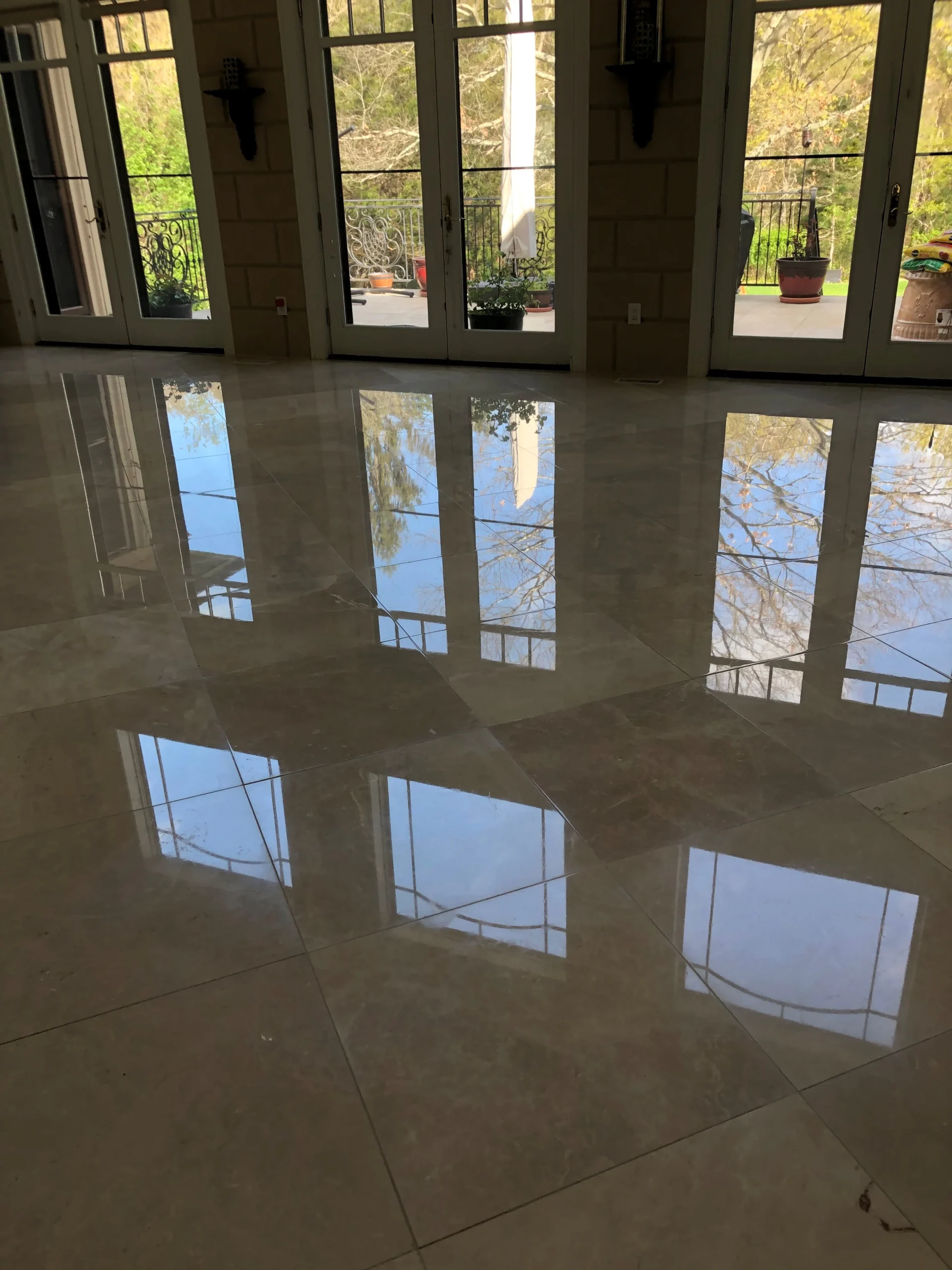
Yes, and often they restore better than newer floors. Older marble was typically higher quality material, quarried from better sections and installed by people who knew what they were doing.
The age itself isn’t the problem. The problem is usually decades of wrong cleaning products, harsh chemicals, or amateur repair attempts. Marble is soft enough that acidic cleaners etch the surface every time they’re used. Over years, that etching builds up until the floor looks hazy and dull no matter how much you clean it.
Restoration removes that damaged surface layer and brings you back to clean stone. As long as the marble itself is intact and hasn’t been ground down too many times before, it can be restored. We’ve brought back floors in Southold that are well over a century old and had them looking like new installations.
Cleaning removes dirt. Polishing adds shine to a surface that’s already smooth. Restoration fixes damage that cleaning and polishing can’t touch.
If your marble is etched from acidic cleaners, scratched from grit and traffic, or worn down in high-traffic areas, cleaning won’t help. You’re looking at physical damage to the stone surface. That requires grinding away the damaged layer, then honing and polishing the fresh stone underneath.
Most cleaning companies don’t have the equipment or knowledge to do this. They’ll keep cleaning, which often makes things worse if they’re using the wrong products. Real marble restoration involves diamond abrasives, specialized equipment, and understanding how different types of marble respond to different processes. It’s restoration work, not janitorial work.
You can try, but the replacement tiles won’t match. Even if you order the same marble by name from the same quarry, the stone will look different.
Quarries shift over time. The color changes as they dig deeper or move to different sections. The veining patterns are different. What you end up with is obviously newer tile sitting next to your original floor, and it’ll stand out every time light hits it.
This is especially true for historic homes in Southold and throughout Nassau and Suffolk Counties. The marble in Gold Coast era homes and older North Fork properties came from quarry sections that aren’t accessible anymore. Some of those quarries don’t even exist now. You literally cannot buy the same stone.
Restoration keeps your original floors intact. Everything matches because it’s all original material. And you’re not throwing away marble that’s survived a century just because it needs professional attention.
Most residential marble floor restoration takes between one and three days depending on the size of the area and the condition of the stone. Bathrooms are usually a day. Larger entrance halls or living spaces might take two to three days.
You can’t use the space while we’re working. The equipment is loud, there’s dust control involved, and the floor needs to cure properly between steps. We’re not just running a buffer over the surface—we’re grinding, honing, and polishing, which requires the space to be clear.
After we’re done, you can walk on the floors immediately. There’s no drying time or curing period for the marble itself. We’ll give you guidance on what to use for cleaning going forward, because using the right maintenance products is how you keep restored marble looking good for years instead of months.
Honing gives you a matte or satin finish. Polishing gives you a glossy, reflective finish. Which one is right depends on the marble type and how your floors were originally finished.
Not all historic marble was meant to be high-gloss. Some installations were honed on purpose for a softer look or because the specific marble type looks better without a mirror shine. Forcing a high polish on stone that wasn’t meant for it can look wrong and won’t hold up as well.
We match the finish to what’s appropriate for your specific floors. That means looking at the marble type, understanding how it was finished originally, and considering how the space is used. High-traffic areas sometimes do better with a honed finish because it hides wear better than high polish. Bathrooms and formal spaces often look better polished. There’s no one-size-fits-all answer, which is why experience with historic marble matters.
Not if you maintain them correctly. Properly restored marble that’s cleaned with the right products can go decades before needing another full restoration.
The key is what you use for regular cleaning. PH-neutral cleaners made for natural stone. Nothing acidic—no vinegar, no lemon, no standard household cleaners that list “citrus” or “fresh scent” on the label. Those are usually acidic and they’ll etch marble every single time you use them.
We give you specific maintenance guidance after restoration. Follow it, and your floors will stay looking good for years. Ignore it and use whatever’s under the kitchen sink, and you’ll be calling us back in two years wondering why the marble looks dull again. The stone itself is durable. It’s the maintenance that makes or breaks longevity.