

You’re not looking at stains. Those dull spots spreading across your marble floor are etch marks—chemical damage from decades of the wrong cleaners touching calcium carbonate. Every time someone used an acidic product, they dissolved a microscopic layer of stone. Now you’re left with uneven wear patterns that no amount of scrubbing will fix.
Restoration reverses that damage. We’re talking about honing away the etched surface, removing scratches from a century of foot traffic, and polishing the stone back to its original finish. The marble that’s been hidden under years of deterioration comes back. The veining gets clear again. The reflection returns.
This isn’t a cover-up. You’re not sealing over problems or applying a topical finish that’ll wear off in two years. We’re removing damaged stone and exposing the intact material underneath. That’s why restored marble lasts—because you’re working with the actual stone, not a temporary fix.
We specialize in the floors that other companies won’t touch. The ones in Sayville’s historic homes from the 1880s and 1920s—the Gold Coast era properties where the marble has been walked on for over a hundred years. The worse the floor, the better the result we can deliver.
We’re owner-operated, which means you’re talking directly to the person doing the work. No project managers. No miscommunication between sales and the crew. When you call, you’re getting 25+ years of hands-on experience, including recognition from the New York Times back in 2001 for this exact type of work.
Sayville’s housing stock is older than most of Long Island. These floors weren’t installed with modern moisture barriers. They’ve survived decades of well-intentioned but damaging cleaning. They need someone who understands historic materials—not just marble in general, but marble that’s been in place since before World War II.
First, we assess the damage. Not all dull marble needs the same treatment. Etching requires honing. Scratches need grinding. Worn traffic patterns might need lippage removal before we can even start polishing. We’re looking at the actual condition of your stone—not selling you a one-size-fits-all package.
Then we start with the lowest grit necessary to remove the damage. If your floor has deep etching or lippage, we’re grinding with metal-bond diamonds to level the surface. For lighter damage, we start with resin-bond abrasives. We work through progressively finer grits—sometimes eight or ten different passes—until the scratches from the previous grit are completely gone.
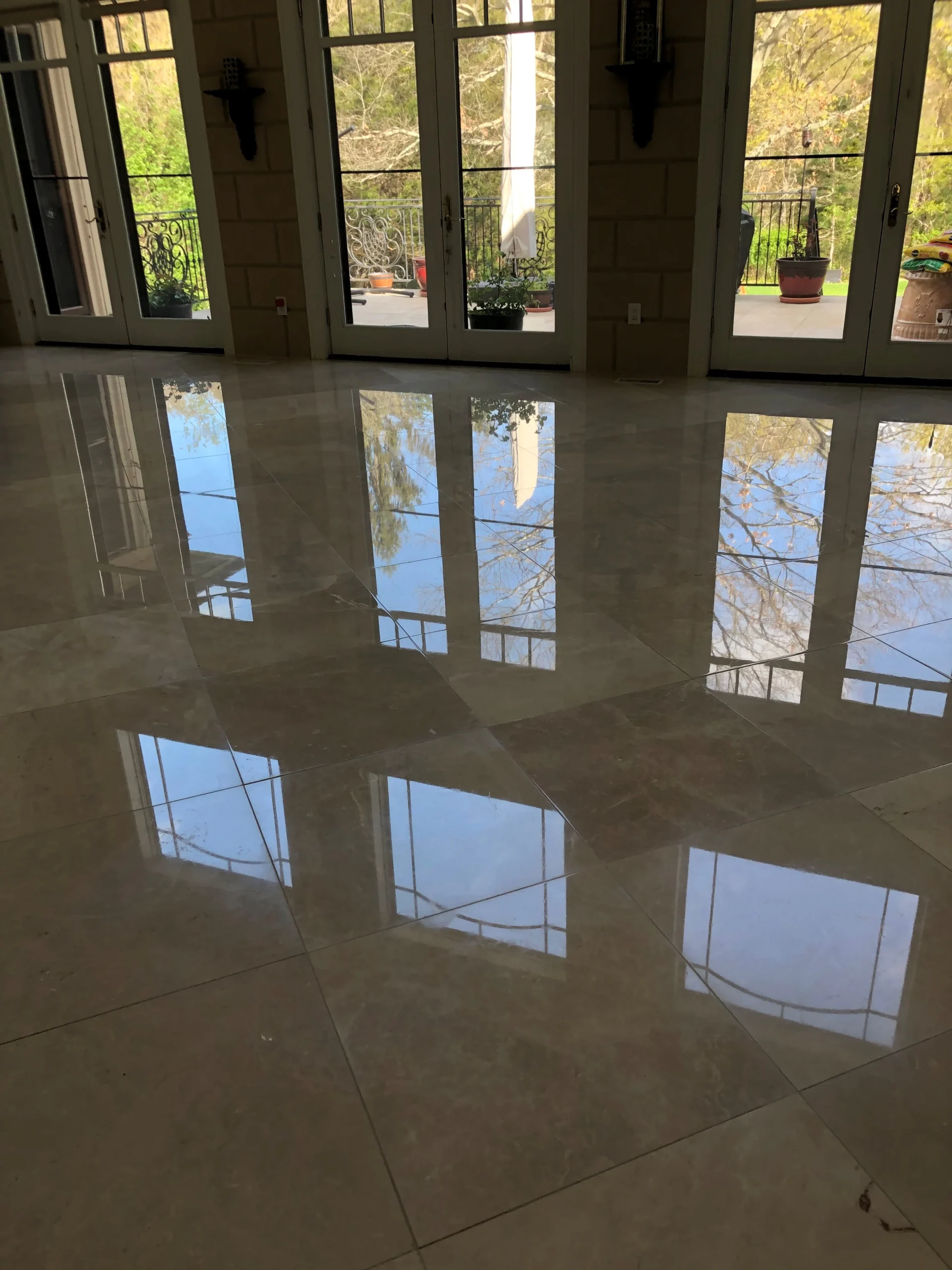
Polishing comes last. This is where we bring back the shine using finer and finer abrasives until the marble reflects light the way it did when it was first installed. On historic floors, we’re often revealing stone that hasn’t seen daylight in 50 years. The color comes back. The depth returns. You see the actual marble again, not the damaged surface layer you’ve been living with.
The timeline depends on square footage and damage severity, but most residential floors take two to four days. We’re not rushing. We’re removing decades of damage in a way that doesn’t create new problems.

Ready to get started?
You’re getting marble floor polishing that addresses the specific problems in Nassau County’s older homes. Water damage from inadequate moisture barriers. Etching from acidic cleaners that were considered safe in the 1970s. Traffic wear that’s created uneven surfaces where some areas are polished and others are completely matte.
We also handle bathroom floor restoration, which is where most of the severe etching happens. Decades of soap, shampoo, and cleaning products create layers of chemical damage. Small bathrooms in historic Sayville homes often have original marble that’s been exposed to moisture and acids for a century. That stone needs honing and repolishing to come back.
If you’ve got concrete floors you’re considering, we’ve added concrete restoration and polishing to our services. Same approach—grind, hone, polish—but different materials and different equipment. It’s an option for basements or additions where you want a polished floor without installing new stone.
Every project starts with a free quote. We come out, look at your floors, tell you what’s fixable and what’s not, and give you transparent pricing. No surprises. No upselling services you don’t need. You’re talking directly to the owner, and we’re licensed in Nassau and Suffolk counties to do this work.
Restoration typically costs 40-60% less than replacement, but the real savings show up in what you’re keeping. If you rip out century-old marble from a historic Sayville home, you’re losing irreplaceable material. The marble quarries that supplied stone in the 1920s aren’t producing the same quality anymore. You can’t just order matching material.
Replacement also means demo, disposal, subfloor repair, and installation of new stone. You’re paying for labor to remove the old floor, haul it away, fix whatever’s underneath, and set new marble. Then you’re waiting weeks for the thin-set to cure before you can polish it. Restoration skips all of that. We work with what’s already there.
The cost depends on square footage and damage severity. A 200-square-foot entryway with moderate etching runs differently than a 1,000-square-foot floor with lippage and deep scratches. We give you an exact number after seeing the floor in person—no ballpark estimates over the phone.
Yes, as long as the damage is on the surface. Etching from acidic cleaners dissolves the calcium carbonate in marble, leaving dull spots or rough patches. That damage usually only goes a few millimeters deep, which means we can hone it away and expose undamaged stone underneath.
The process involves grinding with progressively finer abrasives until the etched layer is completely removed. Then we polish the newly exposed surface back to a high shine. You’re not covering the damage—you’re eliminating it. The marble that comes back is the original stone, just with a few millimeters less thickness.
The exception is if someone used an extremely aggressive acid and left it sitting for a long time. Deep etching that’s gone beyond the surface layer can compromise the structural integrity of the stone. We’ll tell you during the assessment if that’s the case. Most residential damage from household cleaners is fixable. It’s the commercial-grade strippers or prolonged exposure that create problems we can’t reverse.
Decades, if you maintain it correctly. The stone itself is the same marble that’s been in your Sayville home for a hundred years—it’s not going anywhere. What determines longevity is how you clean it and what kind of traffic it sees.
After restoration, you need pH-neutral cleaners only. No vinegar, no ammonia, no acidic products. Water and a stone-safe soap for regular cleaning. If you spill something acidic, wipe it up immediately—don’t let it sit. Those two things prevent new etching from forming.
High-traffic areas will eventually show wear. Entryways, kitchens, hallways—anywhere people walk constantly. You might need a maintenance polish every 10-15 years in those spots, but that’s a light service compared to full restoration. Low-traffic areas like dining rooms or formal spaces can go 20-30 years without needing anything beyond regular cleaning. The stone doesn’t wear out. The finish just dulls from use, and that’s fixable with a single polishing pass.
Honing removes damage. Polishing creates shine. They’re two different steps in the restoration process, and you need both if your floor has scratches or etching.
Honing uses coarser abrasives—usually 100 to 400 grit—to grind away the damaged surface layer. If your marble has etch marks, scratches, or uneven wear, honing removes that material and creates a uniform, smooth surface. The result is matte or satin, not shiny. You’re leveling the stone and eliminating imperfections, but you’re not creating reflection yet.
Polishing comes after honing. We use finer abrasives—800 grit up to 3,000 or higher—to refine the surface until it reflects light. This is where the shine comes back. Polishing doesn’t fix damage; it only works on stone that’s already smooth and level. If you try to polish over etching or scratches, you’ll just have shiny damaged marble.
Some people want a honed finish instead of polished. That’s a design choice. Honed marble has a matte look that hides wear better and feels less formal. Polished marble is glossy and reflective—the traditional finish you see in historic homes. Both are legitimate options. We can deliver either one depending on what you’re after.
Yes. Bathrooms and kitchens are where we see the most severe damage, and they’re also where restoration makes the biggest visual difference. Decades of soap scum, shampoo, cleaning products, and water exposure create etching that turns marble dull and rough.
Bathroom floor restoration is tricky because you’re working in a small space with fixtures, toilets, and vanities in the way. We can work around those obstacles, but access matters. If your marble runs under the toilet flange, we can’t hone that section without removing the toilet. Same with vanities that are sitting on top of the marble. We’ll tell you upfront what’s accessible and what’s not.
Kitchens have different challenges. Food acids, spilled drinks, and heavy foot traffic create uneven wear. The area in front of the sink usually shows the most damage because that’s where water and cleaning products accumulate. We restore those floors the same way we handle any other marble—hone away the damage, polish it back—but we’re often dealing with more severe etching than you’d see in a living room or hallway. The results are worth it. A restored kitchen floor changes the entire feel of the space.
If the damage is only on the surface—etching, scratches, dullness, stains—you need restoration, not replacement. Surface damage is fixable because we can grind it away and expose undamaged stone underneath. That covers about 90% of the floors we see in Sayville’s historic homes.
Replacement becomes necessary when the structural integrity of the marble is compromised. Deep cracks that go all the way through the tile. Sections where the stone has delaminated from the subfloor. Severe lippage that would require removing too much material to level. Those are rare, but they happen—especially in homes where water damage has been ignored for decades.
The only way to know for sure is an in-person assessment. We’ll look at your floor, test the surface, check for structural issues, and tell you whether restoration will work. If replacement is the only option, we’ll say that. We’re not going to sell you a restoration job that won’t hold up. You’re getting a straight answer based on 25+ years of looking at floors exactly like yours. Call us for a free quote, and we’ll walk you through what’s actually needed.