
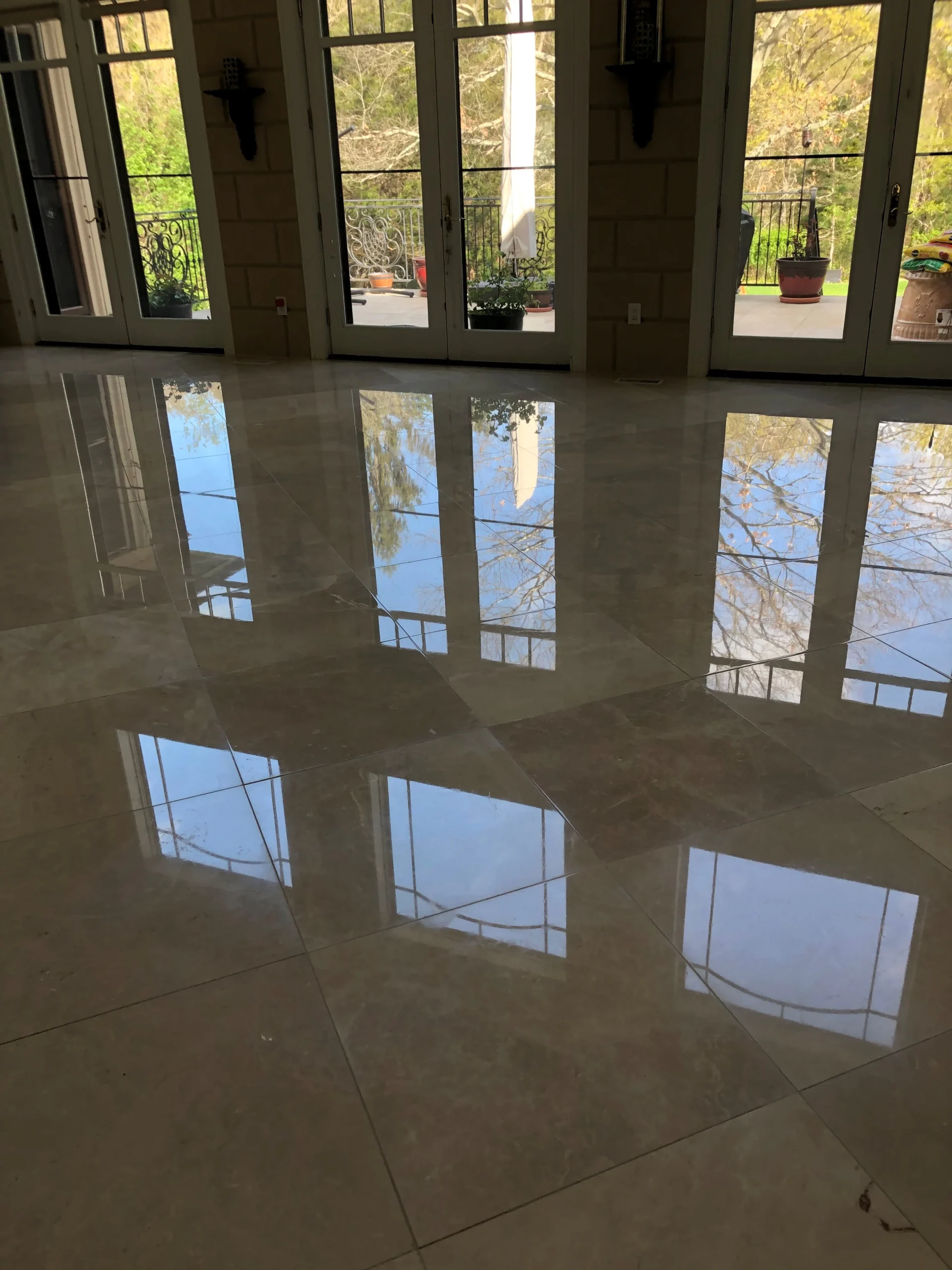
You get floors that look as good as the day they were installed. Not “improved” or “refreshed”—actually restored to their original finish. The etching from decades of foot traffic disappears. The dull spots from acidic spills are gone. The surface becomes uniform again.
This matters because your marble floors aren’t just old—they’re part of what makes your home worth owning. Riverside sits in the heart of Long Island’s Gold Coast region, where estates from the early 1900s still stand with their original marble intact. Those floors were hand-finished with techniques that modern installation doesn’t replicate.
Professional marble floor polishing removes the damaged surface layer and creates a new finish. You’re not covering up problems or applying temporary solutions. The process addresses the actual damage at the surface level, which is why restored floors can last another century when maintained properly.
The cost runs 70-80% less than replacement. You’re looking at $600-$1,500 for restoration versus $3,000-$8,000+ to rip out and reinstall. And you keep the original material that adds value to your property.
High Definition Marble Restoration Inc specializes in the restoration work that most contractors won’t touch. Century-old floors. Complex historic materials. Projects where the margin for error is zero because you can’t just replace what’s there.
We’re owner-operated, which means every project gets direct attention from someone who’s been doing this for over 25 years. No crews working unsupervised. No subcontractors learning on your irreplaceable floors.
The New York Times featured our work back in 2001 for historic restoration expertise. That’s not something you earn by doing average work on new construction. Riverside and the surrounding Nassau County area have some of the most significant historic properties on Long Island, and we’ve built our reputation restoring the floors inside them.
You get free quotes, transparent pricing, and direct communication throughout the project. No surprises. No upselling. Just honest assessment of what’s possible and what it costs.
First, we evaluate your floors in person. Not every floor needs full restoration, and we’ll tell you if yours doesn’t. We look at the type of damage, the original finish, and what’s realistic to achieve given the current condition.
If restoration makes sense, we start with surface preparation. This means protecting everything around the work area and removing any coatings or sealers that might be on the marble. Old floors sometimes have layers of wax or topical sealers from previous attempts to “fix” them.
The actual restoration uses diamond abrasives in progressive grits. We start coarse to remove the damaged surface layer, then move through finer grits to refine the finish. This is where experience matters—historic marble often had hand-finished surfaces with subtle variations. Machine polishing can replicate that if you know what you’re doing. It destroys it if you don’t.
Final polishing brings the marble to the desired finish level. Some clients want high gloss. Others prefer the softer honed finish that matches the original installation. We finish with a penetrating sealer that protects against future staining without changing the appearance.
The timeline depends on square footage and condition, but most residential projects complete in 1-3 days. You can walk on the floors immediately after we’re done.

Ready to get started?
You get complete surface renewal. That includes removing etching, scratches, and wear patterns that have built up over decades. It includes leveling uneven areas where the marble has worn down along traffic paths. And it includes restoring the uniform appearance across the entire floor.
Bathroom floor restoration follows the same process but requires extra attention to water damage and etching around fixtures. Bathrooms see more acidic exposure from cleaning products and personal care items, which means the damage is often more severe than in other rooms.
We also handle marble repair for cracks, chips, and missing pieces. This involves filling and color-matching to blend repairs into the surrounding stone. It’s detailed work, but it’s what keeps historic floors intact instead of requiring replacement sections.
Riverside’s historic homes often feature marble in entryways, bathrooms, and kitchens—the high-traffic and high-exposure areas where damage accumulates fastest. These are also the areas where original marble adds the most character and value to your property. Proper restoration maintains that value while eliminating the damage that makes floors look neglected.
The protective sealing we apply after polishing isn’t a coating that sits on top of the marble. It’s a penetrating sealer that fills the pores in the stone and prevents liquids from soaking in. This gives you time to wipe up spills before they stain or etch the surface.
Most single rooms take one full day from start to finish. Larger spaces or whole-floor projects can run two to three days depending on square footage and the extent of damage.
The timeline depends on how much surface material we need to remove to get below the damage. Light etching and surface scratches come out quickly. Deep wear patterns or previous damage from harsh chemicals take longer because we’re removing more material to reach undamaged stone.
We work in sections and complete each area fully before moving to the next. This means part of your floor is finished and walkable while we’re still working on other sections. You don’t lose access to your entire space for days at a time.
Yes. Deep scratches and etching are exactly what the restoration process is designed to fix. We’re removing the damaged surface layer entirely and creating a new finish, so the depth of existing damage just determines how much material we need to remove.
The limitation is the thickness of your marble. Floor marble is typically thick enough to handle multiple restorations over its lifetime. We measure before starting to make sure there’s adequate material to work with.
Etching from acidic substances like wine, citrus, or harsh cleaners creates dull spots that won’t come out with cleaning. The acid literally dissolves the surface of the marble. Restoration removes that damaged layer and re-polishes the stone underneath. The etching disappears completely because we’ve removed the part of the marble where it existed.
Restoration typically costs 70-80% less than full replacement. You’re looking at roughly $600-$1,500 for professional restoration of a standard room versus $3,000-$8,000+ to remove and reinstall new marble.
The cost difference comes from labor and materials. Restoration works with what’s already there. Replacement means demolition, disposal, new material, new installation, and dealing with the subfloor and transitions. It’s a much bigger project.
The other factor is that you can’t always replace historic marble with equivalent material. The marble in older Riverside homes often came from quarries that no longer operate or was selected for specific veining and color. Restoration keeps your original floors intact, which matters both for authenticity and property value.
No special products. You just need to avoid the acidic cleaners and harsh chemicals that damage marble in the first place. Regular damp mopping with pH-neutral cleaner is all it takes.
The protective sealer we apply gives you a buffer against everyday spills and dirt. It doesn’t make the marble indestructible, but it does give you time to wipe up acidic spills before they etch the surface. Resealing every few years maintains that protection.
What damages marble is acidic contact—things like vinegar-based cleaners, citrus, wine, and some bathroom products. These dissolve the calcium carbonate in the stone and create dull spots. If you keep acidic substances off the marble and clean with neutral products, your restored floors will stay in good condition for decades. It’s not complicated maintenance. It just requires knowing what not to use.
Yes. Bathrooms and kitchens are actually where we do a lot of our work because that’s where marble takes the most damage. Acidic exposure is higher in these rooms, which means etching and dullness show up faster.
Bathroom floor restoration involves the same process as other rooms, but we pay extra attention to areas around toilets, tubs, and showers where water damage and cleaning product damage accumulate. These areas often need more surface material removed to get below the damage layer.
Kitchens present similar challenges. Spills happen more frequently, and acidic foods contact the marble more often. We restore kitchen floors, islands, and countertops using the same diamond abrasive process. The key is removing enough damaged material to create a uniform new surface while preserving the original stone thickness.
Yes, and we see this more often than you’d expect. Many cleaning companies offer marble restoration as an add-on service without the training to do it properly. They use harsh acids or extremely aggressive abrasives that create new damage while trying to fix existing problems.
The most common issue we fix is uneven surfaces from improper grinding. If someone uses too much pressure or doesn’t keep the equipment level, they create waves and low spots in the marble. Correcting this requires removing additional material to level everything out again.
We also fix damage from acidic restoration attempts. Some contractors use acid washes to remove stains or etching, which just creates more etching across a wider area. The only way to fix acid damage is to grind it out and re-polish the surface. There’s no chemical shortcut. This is skilled work, and it’s why we’ve specialized in complex historic restoration since 1998. The worse the existing damage, the more important it is that the restoration is done right the first time.